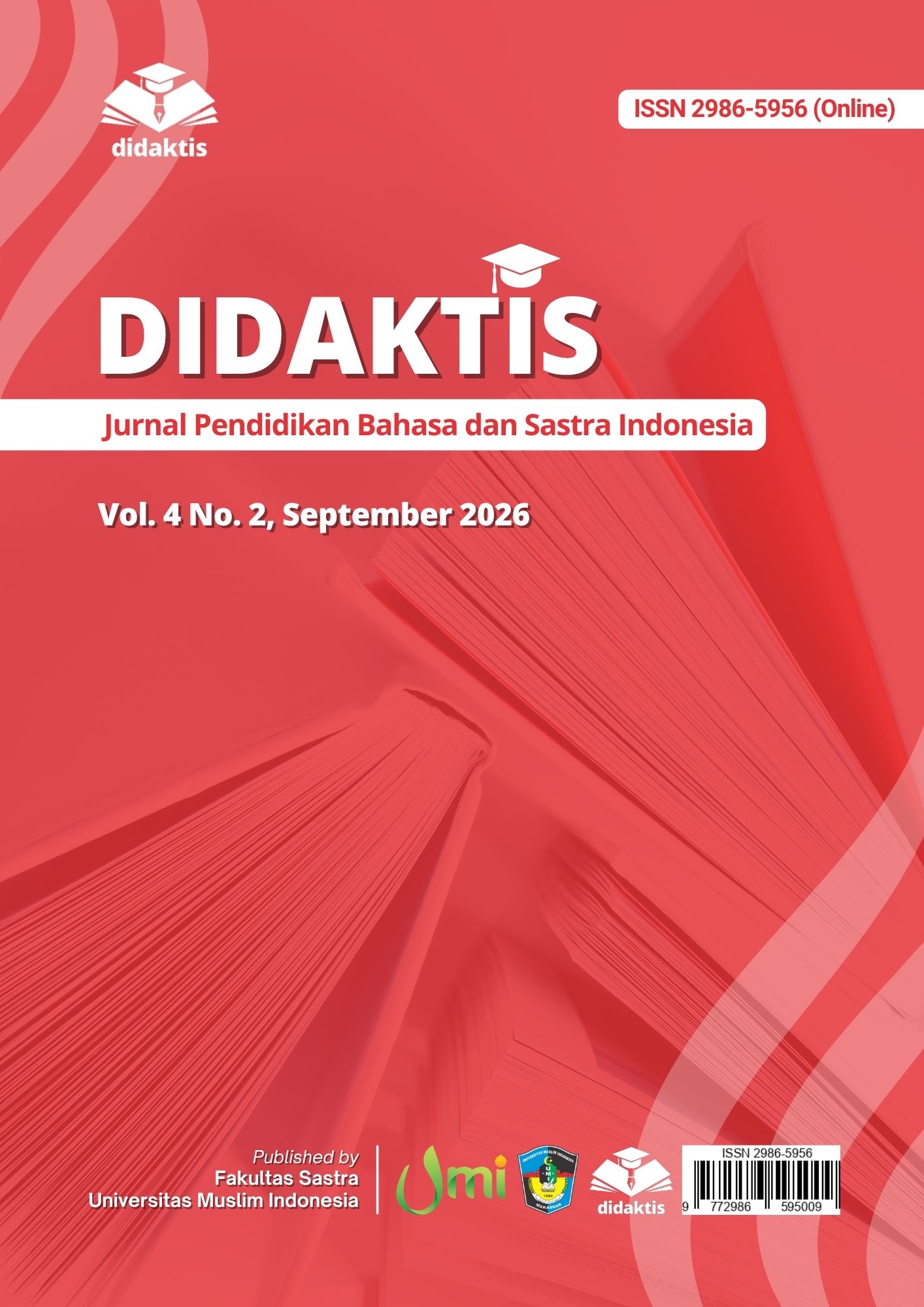
Reading in a digital ecology: University students’ inferential reading comprehension across the social media landscape
DOI:
https://doi.org/10.33096/didaktis.v4i2.1232Keywords:
digital ecology, digital platform, inferential reading comprehension, social mediaAbstract
This study examined differences in university students’ inferential reading comprehension according to the number of social media platforms they used. A quantitative comparative design was employed with 492 students from four universities in South Sulawesi, Indonesia. Data were collected through Microsoft Forms using a 15-item inferential reading comprehension test and analyzed using descriptive statistics, one-way ANOVA, and Tukey’s HSD post hoc test. Mean scores increased across the 1–3 platform group (M = 9.0385), the 4–6 platform group (M = 9.5818), and the 7–9 platform group (M = 9.7500). The ANOVA indicated a significant overall group difference, F (2, 489) = 3.561, p = .029, with a small effect size (η² = .014). Tukey’s HSD showed a significant difference only between the 1–3 and 4–6 platform groups. These findings suggest that the breadth of social media platform use is associated with inferential reading comprehension, although the association is small and not fully linear. The study highlights the potential value of integrating critical digital literacy into reading instruction in higher education.
Downloads
References
Abd Halim, N. D., Abdul Mutalib, M., Mohd Zaid, N., Mokhtar, M., Abd Majid, F., & Sharil, W. N. E. H. (2024). The use of social media to enhance critical thinking in online learning among higher education students. International Journal of Interactive Mobile Technologies, 18(6), 56–66. https://doi.org/10.3991/ijim.v18i06.48033
Aloraini, N., & Cardoso, W. (2022). Social media in language learning: A mixed-methods investigation of students’ perceptions. Computer Assisted Language Learning, 35(8), 1707–1730. https://doi.org/10.1080/09588221.2020.1830804
Altamura, L., Vargas, C., & Salmerón, L. (2024). Do new forms of reading pay off? A meta-analysis on the relationship between leisure digital reading habits and text comprehension. Review of Educational Research, 95(1), 53–88. https://doi.org/10.3102/00346543231216463
Anggia, H., & Habók, A. (2024). University students’ metacognitive awareness of reading strategies in online reading and its role in English reading comprehension. PLOS ONE, 19(11), e0313254. https://doi.org/10.1371/journal.pone.0313254
Badan Pusat Statistik. (2025). Statistik Telekomunikasi Indonesia 2024. Badan Pusat Statistik.
Barrot, J. S. (2023). Using social networking sites as a language teaching and learning environment. Language Teaching, 56(2), 181–196. https://doi.org/10.1017/S0261444822000167
Basri, B. M., Rapi, M., Ilham, M., Yasinta, N, I. (2024). Digital versus print: an Exploration of students’ comprehension based on reading type. Jurnal Nalar Pendidikan, 12(2), 116-121. https://doi.org/10.26858/jnp.v12i2.67127
Carcamo, B. (2025). Developing EFL students’ multimodal literacy with the use of infographics. Asian-Pacific Journal of Second and Foreign Language Education, 10, 1–23. https://doi.org/10.1186/s40862-025-00322-3
Chang, L., Wang, Y., Liu, J., Feng, Y., & Zhang, X. (2023). Study on factors influencing college students’ digital academic reading behavior. Frontiers in Psychology, 13, 1007247. https://doi.org/10.3389/fpsyg.2022.1007247
Delgado, P., Anmarkrud, Ø., Avila, V., Altamura, L., Chireac, S. M., Pérez, A., & Salmerón, L. (2022). Learning from text and video blogs: Comprehension effects on secondary school students. Education and Information Technologies, 27, 5249–5275. https://doi.org/10.1007/s10639-021-10819-2
Dontre, A. J. (2021). The influence of technology on academic distraction: A review. Human Behavior and Emerging Technologies, 3(3), 379–390. https://doi.org/10.1002/hbe2.229
Duke, N. K., & Cartwright, K. B. (2021). The science of reading progresses: Communicating advances beyond the Simple View of Reading. Reading Research Quarterly, 56(S1), S25–S44. https://doi.org/10.1002/rrq.411
Furenes, M. I., Kucirkova, N., & Bus, A. G. (2021). A comparison of children’s reading on paper versus screen: A meta-analysis. Review of Educational Research, 91(4), 483–517. https://doi.org/10.3102/0034654321998074
Galindo-Domínguez, H., Bezanilla, M. J., & Campo, L. (2025). Relationship between social media use and critical thinking in university students. Education and Information Technologies, 30, 6641–6665. https://doi.org/10.1007/s10639-024-12953-z
Habók, A., Oo, T. Z., & Magyar, A. (2024). The effect of reading strategy use on online reading comprehension. Heliyon, 10(2), e24281. https://doi.org/10.1016/j.heliyon.2024.e24281
Howard-Gosse, A., Bergey, B. W., & Deacon, S. H. (2024). The reading challenges, strategies, and habits of university students with a history of reading difficulties and their relations to academic achievement. Journal of Learning Disabilities, 57(2), 91–105. https://doi.org/10.1177/00222194231190678
Kolhar, M., Kazi, R. N. A., & Alameen, A. (2021). Effect of social media use on learning, social interactions, and sleep duration among university students. Saudi Journal of Biological Sciences, 28(4), 2216–2222. https://doi.org/10.1016/j.sjbs.2021.01.010
Kuhn, A., Schwabe, A., Boomgaarden, H., Brandl, L., Stocker, G., Lauer, G., Brendel-Kepser, I., & Krause-Wolters, M. (2024). Who gets lost? How digital academic reading impacts equal opportunity in higher education. New Media & Society, 26(2), 1034–1055. https://doi.org/10.1177/14614448211072306
Lambton-Howard, D., Kiaer, J., & Kharrufa, A. (2021). “Social media is their space”: Student and teacher use and perception of features of social media in language education. Behaviour & Information Technology, 40(16), 1700–1715. https://doi.org/10.1080/0144929X.2020.1774653
Lee, S., Kuo, L. J., Xu, Z., & Hu, X. (2022). The effects of technology-integrated classroom instruction on K–12 English language learners’ literacy development: A meta-analysis. Computer Assisted Language Learning, 35(5–6), 1106–1137. https://doi.org/10.1080/09588221.2020.1774612
Luan, L., Liang, J. C., Chai, C. S., Lin, T. B., & Dong, Y. (2020). Development of the new media literacy scale for EFL learners in China: A validation study. Interactive Learning Environments. https://doi.org/10.1080/10494820.2020.1774396
Martin, F., Kumar, S., & Bolliger, D. U. (2025). Digital distractions in education: A systematic review of research on causes, consequences and prevention strategies. Educational Technology Research and Development. https://doi.org/10.1007/s11423-025-10550-6
McCarthy, K. S., & McNamara, D. S. (2021). The Multidimensional Knowledge in Text Comprehension framework. Educational Psychologist, 56(3), 196–214. https://doi.org/10.1080/00461520.2021.1872379
Medranda-Morales, N., Palacios-Mieles, V., & Villalba-Guevara, M. (2023). Reading comprehension: An essential process for the development of critical thinking. Education Sciences, 13(11), 1068. https://doi.org/10.3390/educsci13111068
Ngwoke, F., Agbo, I., & Ogenyi, L. (2024). Effects of addiction to the use of social media on the reading habits of students of English language studies, University of Nigeria, Nsukka. Interactive Learning Environments, 32(6), 2874–2883. https://doi.org/10.1080/10494820.2022.2160765
Orellana, P., Silva, M., & Iglesias, V. (2024). Students’ reading comprehension level and reading demands in teacher education programs: The elephant in the room? Frontiers in Psychology, 15, 1324055. https://doi.org/10.3389/fpsyg.2024.1324055
Paige, D., Rupley, W. H., & Ziglari, L. (2024). Critical thinking in reading comprehension: Fine tuning the Simple View of Reading. Education Sciences, 14(3), 225. https://doi.org/10.3390/educsci14030225
Pianzola, F. (2022). Readers’ engagement through digital social reading on Twitter: The TwLetteratura case study. Library Hi Tech, 40(5), 1305–1322. https://doi.org/10.1108/LHT-12-2020-0317
Pianzola, F., Rebora, S., & Lauer, G. (2020). Wattpad as a resource for literary studies: Quantitative and qualitative examples of the importance of digital social reading and readers’ comments in the margins. PLOS ONE, 15(1), e0226708. https://doi.org/10.1371/journal.pone.0226708
Rice, M., Wijekumar, K., Lambright, K., & Bristow, A. (2024). Inferencing in Comprehension: Variations Instruction, in Reading Examining Definition, and Assessment. Technology, Knowledge and Learning, 29(3), 1169–1190. https://doi.org/10.1007/s10758-023-09660-y
Samiei, F., & Ebadi, S. (2021). Exploring EFL learners’ inferential reading comprehension skills through a flipped classroom. Research and Practice in Technology Enhanced Learning, 16, 12. https://doi.org/10.1186/s41039-021-00157-9
Shamsi, E., & Bozorgian, H. (2022). A review of empirical studies of social media on language learners’ willingness to communicate. Education and Information Technologies, 27, 4473–4499. https://doi.org/10.1007/s10639-021-10792-w
Ssekiziyivu, B., Mukoki, J., & Musoke, E. (2023). Adopting social media for learning among university students: A developing country perspective. Interactive Learning Environments, 31(8), 5007–5020. https://doi.org/10.1080/10494820.2021.1992638
Sugerman, Santoso, A., & Sumadi. (2024). Ketransitifan dalam status Facebook: Perspektif linguistik fungsional sistemik. Ranah: Jurnal Kajian Bahasa, 13(1), 141–151. https://doi.org/10.26499/rnh.v13i1.5497
Wang, Y. (2023). Enhancing English reading skills and self-regulated learning through online collaborative flipped classroom: A comparative study. Frontiers in Psychology, 14, 1255389. https://doi.org/10.3389/fpsyg.2023.1255389
Widyaningrum, A. G., Hubeis, A. V. S., Sarwoprasodjo, S., & Matindas, K. (2023). Komunikasi kesehatan persalinan dalam media sosial: Kajian literatur sistematik. Jurnal Ilmu Komunikasi, 21(3), 348–368. https://doi.org/10.31315/jik.v21i3.7843
Downloads
Published
Issue
Section
License
Copyright (c) 2026 Iin Nur Yasinta, Sakaria Sakaria, Abdul Haliq, Muh. Bahly Basri

This work is licensed under a Creative Commons Attribution-ShareAlike 4.0 International License.