JOURNAL INFORMATION
TEMPLATE


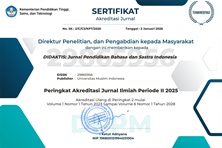
ACCREDITATION & INDEXING







VISITORS
CITATION METRICS
RECOMMENDED TOOLS



GENERAL REQUIREMENTS
Please read and understand the author's guidelines for the preparation manuscript. The author who submits a manuscript to the editors should comply with the author's guidelines and template. If the submitted manuscript does not comply with the guidelines or using a different format, it will be rejected by the editorial team before being reviewed. The editorial team will only accept a manuscript that meets the specified formatting requirements (downloadable at: Template). This template is designed to assist Author in preparing manuscript; it is an exact representation of the format expected by the editor. To use this template, please just Save As this MS Word file to your document, then copy and paste your document here. All papers submitted to the journal can be written in Indonesian or English.
PAPER FORMAT
Title
Title of articles are written with Cambria Bold (14 pt) and preferably not more than 14 words, written in sentence case (lowercase except for the first word and words that must be capitalized).
Authors and Affiliations
Provide each author's full name, affiliation, and email. Only the corresponding author's email is displayed on the manuscript's first page; all authors' emails are listed in the About the Authors section at the end of the manuscript. Authors are encouraged to include an ORCID iD for each author.
Abstract
The abstract should be clear, concise, and descriptive, written in a single paragraph of approximately 200 words in single spacing (Cambria 9 pt). It should present the research problem, objective, method, main findings, and a brief conclusion, ending with the study's theoretical or practical implications. The abstract must not contain citations, tables, or figures. Provide 3–5 keywords that describe the substance of the article, written in lowercase (except proper nouns), arranged alphabetically, separated by semicolons (;), with no period at the end.
Introduction
The introduction should be clear and provide the issue to be discussed in the manuscript. At the end of the paragraph, the author/s should end with a comment on the significance concerning identification of the issue and the objective of research. Introduction typed with 1 space (Cambria 11 pt).
Method
The method is written descriptively. The method contains an explanation of the research methodology used by the researcher to produce findings. This section displays the research steps carried out by the author systematically. The method does not contain theory. Method typed with 1 space (Cambria 11 pt).
Results and Discussion
The results section contains a presentation of the results of the data analysis. Present the research results according to the objectives and methods. The discussion section is the most important part of your article. The discussion must show the novelty and significant findings of the research conducted. Results and Discussion typed with 1 space (Cambria 11 pt).
Following APA 7th edition, place the table number and title above the table, and the figure number and caption below the figure (Cambria 9 pt, single spacing). Refer to them directly (e.g., Table 1, Figure 1), not by relative position. Where needed, add a Note beneath the table to explain abbreviations or statistical significance.
Where relevant, the discussion may close by noting the study's limitations affecting the interpretation or generalizability of the findings, along with directions for further research.
Conclusion
The conclusion answers the research objectives on the basis of the findings discussed, rather than repeating the abstract or restating the results. It affirms the main data-supported findings without speculation and elaborates their theoretical and/or practical implications more fully than the brief statement given in the abstract. The conclusion is presented as narrative paragraphs, not as a list or numbered points, typed in Cambria 11 pt, single spacing.
Declarations
Following the Conclusion, authors must include Acknowledgments, Funding, Author Contributions, and Competing Interests statements, with detailed instructions and examples provided in the article template.
References
The reference list follows APA 7th edition. Use up-to-date sources (preferably within the last five years, except for well-established classical theories), with at least 80% drawn from scholarly journals, prioritizing those indexed in Scopus, Web of Science, or SINTA 1–2. A minimum of 30 references is required. Every DOI must be valid and traceable. List only sources cited in the manuscript, arranged alphabetically. Use a reference manager such as Mendeley, EndNote, or Zotero. Citing articles previously published in DIDAKTIS is also recommended. Reference format examples for common source types are provided in the article template.
GUIDELINE FOR ONLINE SUBMISSION
Authors must first register through the following address: https://jurnal.fs.umi.ac.id/index.php/didaktis/user/register. After logging in, go to the Submissions page and click "New Submission" to start the submission wizard. The system will first display a "Before you begin" page, where you enter the submission title, confirm that your manuscript meets every item in the Submission Checklist, and give your Privacy Consent before proceeding. The submission then continues through five steps:
Your submission can be saved and resumed at any time before it is finalized. After finalizing, the corresponding author will receive an email acknowledgement and can track the submission's status and editorial progress by logging in to the journal.

DIDAKTIS: Jurnal Pendidikan Bahasa dan Sastra Indonesia is licensed under a Creative Commons Attribution-ShareAlike 4.0 International License
Published by: Fakultas Sastra, Universitas Muslim Indonesia
Email: jurnal.didaktis@umi.ac.id
Address: Jalan Urip Sumoharjo Km. 5 Makassar, Sulawesi Selatan 90231